Composite Decking Material Cost: What to Know in 2026
August 21, 2026
A well-built deck will become your go-to place for entertaining, relaxing, and enjoying the great outdoors. You've done the research and are likely considering the benefits composite decking has over traditional wood, but what about budgeting? We are here to give you the insight you need on composite decking material cost.
How to think about upfront deck cost
When it comes to your deck and finding the right material option for you, there is more to deck cost than first meets the eye. While the material certainly impacts your project budget, it's just one of several important variables to consider.
Upfront deck costs depend on four main factors: the decking material, the deck design, labor rates, and the condition of the substructure.
Expense factors at time of build
Deck materials
Will you build with maintenance-prone traditional wood or innovative composite or PVC decking?
Design
The size, shape, and pattern of your deck, as well as whether your deck will have multiple levels or railing — all impact project costs.
Labor
Will you DIY some or part of your build or partner with a contractor? Professional labor makes up a significant portion of total deck costs.
Substructure
If you're replacing an existing deck your contractor will inspect your existing substructure to determine whether it's healthy or needs replacing.
Composite decking material cost: The bigger picture
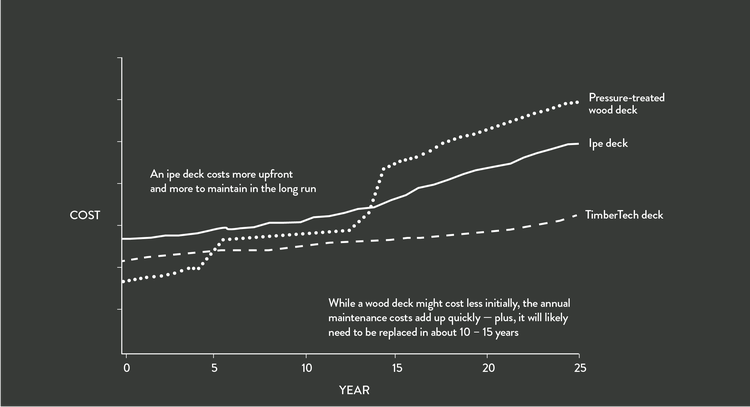
While pressure-treated lumber has a lower initial price tag, composite decking costs significantly less over a 15-year period due to minimal maintenance and replacement requirements compared to wood.
Composite vs. wood decking: 25-year cost comparison
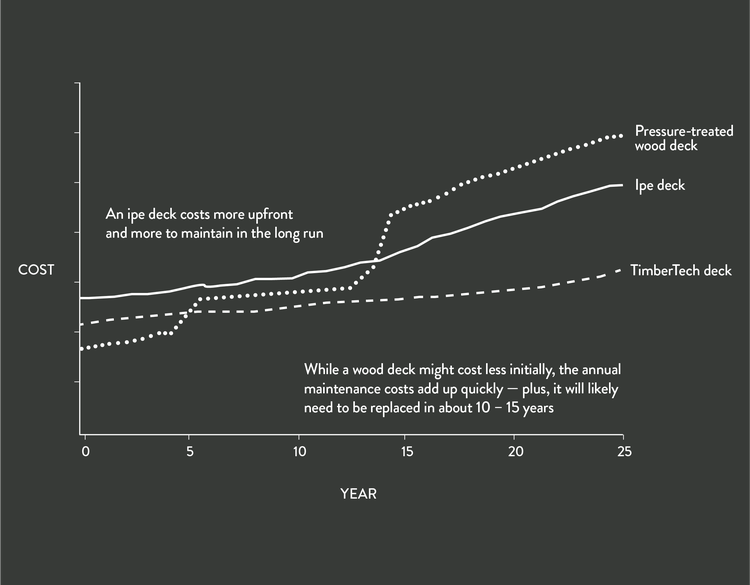
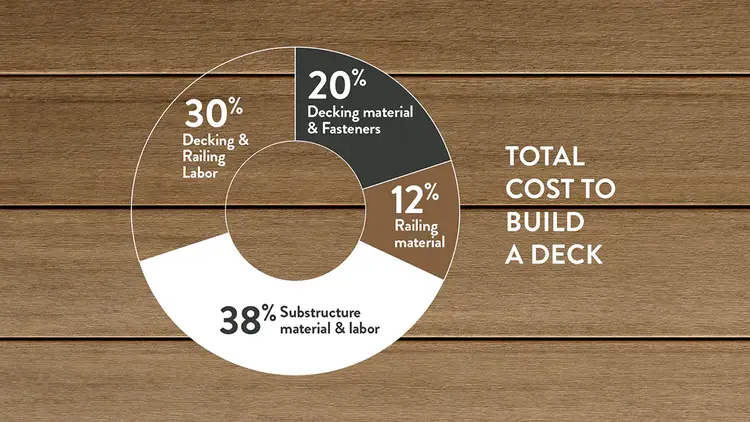
Upgrading from pressure-treated wood to TimberTech Advanced PVC or Composite adds as little as 15% to your total project cost — even though the boards themselves cost 20–40% more. That's because labor and substructure make up the majority of any deck build, regardless of what material you choose. Over 25 years, the savings become even more apparent: No costly sanding, staining, or sealing.
Composite vs. wood decking: 25-year cost comparison
Upgrading from pressure-treated wood to TimberTech Advanced PVC or Composite adds as little as 15% to your total project cost — even though the boards themselves cost 20–40% more. That's because labor and substructure make up the majority of any deck build, regardless of what material you choose. Over 25 years, the savings become even more apparent: No costly sanding, staining, or sealing.
See real-life deck cost examples
Want to get a better idea of how much a composite deck might cost in your area? Our Deck Cost Guide has a comprehensive library of TimberTech decks of all shapes, sizes, and budgets, with details including specific materials, design details, dimensions, and total cost breakdown.
Busting myths around composite decking material cost
In addition to narratives around how composite decking impacts your budget, there are some other common myths about what composite decking will cost you.
Myth 1: Composite decking is costly to the environment
While the idea of plastic in your decking may be an initial turn-off to the sustainably minded, it's important to put the material and its maintenance needs into context as compared to traditional wood.
The reality: TimberTech composite decking supports sustainability
TimberTech Decking is made primarily of recycled materials. Much of this material comes from hard-to-recycle items that might otherwise end up in landfills.
The wood flour in our Composite Decking collections consists of 100% recycled wood fibers. That means we don’t cut down trees in the manufacturing of our decking. TimberTech Advanced PVC Collections include zero natural fibers like wood.
The environmental cost of traditional wood decking
Harvesting traditional lumber requires cutting down trees, and some of this wood comes from forests that lack sustainable management. Exotic hardwoods often come from poorly managed and illegal logging operations, which contributes to devastating deforestation and habitat loss.
While you may still think traditional wood is the organic choice when it comes from well-managed forests, think again.
Pressure-treated lumber: Manufacturers often infuse pressure-treated lumber with chemicals to make it moisture and insect repellant.
Traditional wood: Traditional wood, which includes pressure-treated lumber as well as other softwoods and hardwoods, requires stains to stay attractive. Many of these products expose you, your family, and the environment to harmful chemicals like volatile organic compounds.
Myth 2: Composite decking comes at the cost of aesthetics
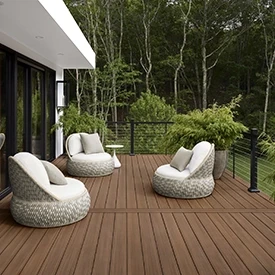
Some competitors fail to capture the nuanced beauty of wood in their engineered deck boards, which has led to a myth that all composite decking has a fake, plastic look. With TimberTech Decking, you get a deck that performs better than wood and delivers a beautiful, real wood look that lasts for decades — no sanding, staining, or sealing required.
The reality: TimberTech Decking looks just as good as wood
The fact is that you don't have to sacrifice looks for performance. TimberTech Decking delivers both a low-maintenance decking experience and nature-inspired aesthetics. If you worry about your deck looking as good as wood, that is one area you don't have to worry about with TimberTech.
Choose the worthwhile investment, choose TimberTech
The cost of a composite deck is about so much more than the upfront price.
Other factors like labor and overall design of your deck often play a larger role in total cost than just your decking material selection. Plus, a TimberTech Composite deck will end up saving you money over time, because it requires far less maintenance than a traditional wood deck.
Get an estimated cost for materials
Ready to dive into your composite decking material cost? Get an estimate based on the size of your deck, the decking material you choose, and your substructure needs from a TimberTech Pro near you.
How much does composite decking cost per square foot in 2026?
In 2026, composite decking boards generally range from $1.75-$8.00 per linear foot for the materials alone. Factoring in professional labor, substructure materials, and the material cost of a deck typically accounts for 20% of total deck cost.
Does building a composite deck increase home value?
Yes, adding a composite deck consistently offers a strong return on investment. Upgrading your outdoor living space with premium, low-maintenance materials adds functional square footage and enhances the curb appeal of your property for future buyers.
Why is composite decking more expensive upfront than wood?
Composite decking requires advanced manufacturing processes and high-quality recycled materials to create a highly durable, moisture-resistant board with a real wood look. While the initial material cost is higher than pressure-treated lumber, composite decking eliminates the need for yearly sanding, staining, and sealing.