The hidden expenses behind wood deck costs in 2026
July 28, 2026
Thinking about building or renovating an outdoor living space, including a deck? Before you start planning your build, you need to understand the expenses associated with your project. While upfront material prices are likely the first thing on your mind, they don’t tell the full story. When it comes to wood deck cost, it’s both the initial price tag and the long-term maintenance costs that will significantly impact how much money you’ll spend over the lifetime of the deck.
What influences the upfront cost of your deck build?
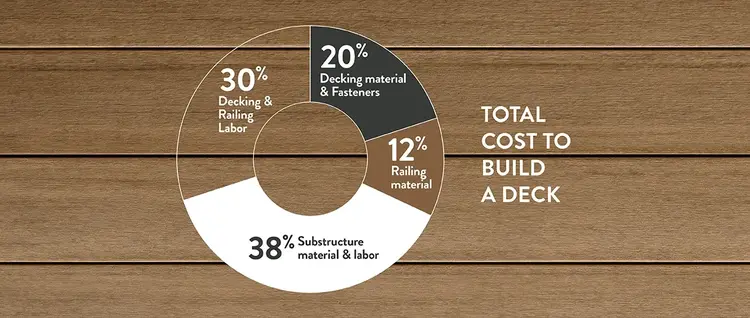
Upfront deck costs depend on your chosen materials, labor fees, deck size, and any custom features. The initial expenses for any deck build include the money you pay to get the structure completed. Material choice — whether wood or an engineered option — is just one factor of many that contributes to total deck replacement cost. Check out our Deck Cost Guide for a complete cost breakdown.
- Materials used: Prices vary among decking material options — pressure-treated wood materials typically run between $0.85-$3.50 per linear foot, while composite decking materials typically cost between $1.75-$8.00 per linear foot
- Labor: The cost of professional labor can vary greatly as it is very impacted by the specifics of the deck (size, shape, layout, etc.) and where the job is located— so think about whether you want to do the work yourself or hire a TimberTech contractor
- Deck size and shape: A larger deck size or a more complex shape requires more materials and labor
- Additional deck features: Planning built-in features like railing, lighting, a pergola, or benches will increase your initial estimate
What are the long-term expenses of a wood deck?
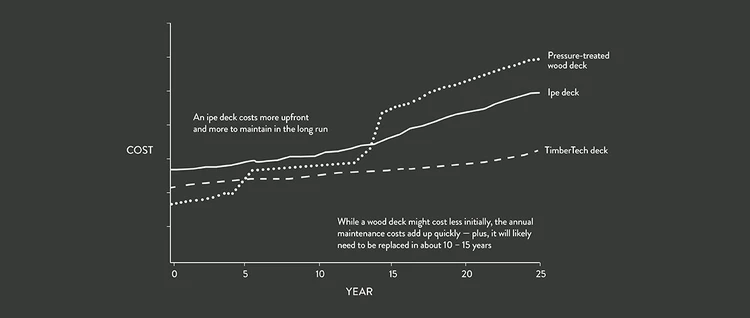
Traditional wood decks demand serious upkeep year over year — require significant annual investments of both time and money for sanding, staining, and sealing. Over time, the monetary cost of wood deck maintenance can quickly add up.
- Cleaning: You need to purchase chemicals to remove mold and mildew, and you may also have to purchase or rent a pressure washer and buy brushes to apply the cleaner
- Sanding: You need to rent or purchase a power sander, along with plenty of sandpaper
- Staining and sealing: You need gallons of your preferred stain and sealer, as well as the proper brushes and rollers
- Labor: If you don’t want to spend hours doing the work yourself, you’ll need to hire professionals to do the work for you
When you think about repeating these expenses every year, it is easy to see why your total wood deck cost piles up. You also spend a lot of time and effort on this schedule; so, say goodbye to relaxing weekends.
Do wood decks require frequent repairs and replacements?
Yes, wood decks require more frequent repairs and replacements than composite alternatives. Minor fixes cost a few hundred dollars, while major structural problems can be thousands or tens of thousands of dollars.
As your wood deck gets older, the likelihood of costly repair work increases. You will need to buy replacement materials like deck boards, fasteners, and joists. You might also need to rent cutting tools or drills. If you do not plan to do the work yourself, you will have to hire additional labor.
Why is traditional wood so costly to maintain?
Traditional wood is an organic material that breaks down when exposed to the elements. UV rays cause fading, while moisture creates the perfect environment for mold and rot.
Whether you use pressure-treated lumber or dense hardwood like ipe, organic wood is vulnerable. You spend a lot of time and money ensuring your deck retains its appearance. Ultimately, wood has a short lifespan, so your total wood deck cost will inevitably include major repairs.
Furthermore, organic does not always mean sustainable. All traditional wood options contribute to deforestation. This takes a serious toll on the environment and impacts the most biodiverse ecosystems in the world.
Is composite decking a better alternative to wood?

Yes, composite and PVC decking offer a better long-term value than traditional wood. TimberTech Decking delivers unrivaled real wood looks without the rigorous maintenance and replacement costs of lumber.
If you want the beauty of wood without the upkeep it requires, you want TimberTech boards. Our Advanced PVC and Composite deck boards are capped with a proprietary blend of polymers. This technology locks in rich color and resists moisture, and the result is a deck designed to resist weathering agents and stay beautiful for decades — no sanding, staining, or sealing required. Ever.
How much time and money does low-maintenance decking save?
You can save hundreds of dollars and hours of labor every year by choosing low-maintenance decking.
Maintenance for TimberTech Decking is simple and affordable. You sweep away dirt with a broom, use a plastic shovel for snow, and wash the surface with TimberTech DeckCleaner, as needed. Compared to the long list of wood deck maintenance costs, you instantly see the savings for your wallet and your time.
How does TimberTech compare to traditional wood deck cost?
While composite decking has a higher initial price, the ten-year cost is often lower than wood due to minimal upkeep.
When you compare our TimberTech Advanced PVC and Composite decking lines with traditional wood counterparts, the value becomes clear. A premium hardwood like Ipe might seem comparable upfront to the Vintage Collection®, but the ten-year costs heavily favor the engineered option. Similarly, pressure-treated lumber costs less initially than the Prime Collection, but maintenance expenses quickly close the gap.
TimberTech decking costs are comparable upfront to premium wood options while boasting serious long-term savings. Save yourself the time, money, and worry by opting for a beautiful, sustainable alternative.
To learn more about costs including understanding how much real projects cost, visit our Deck Cost Guide.